


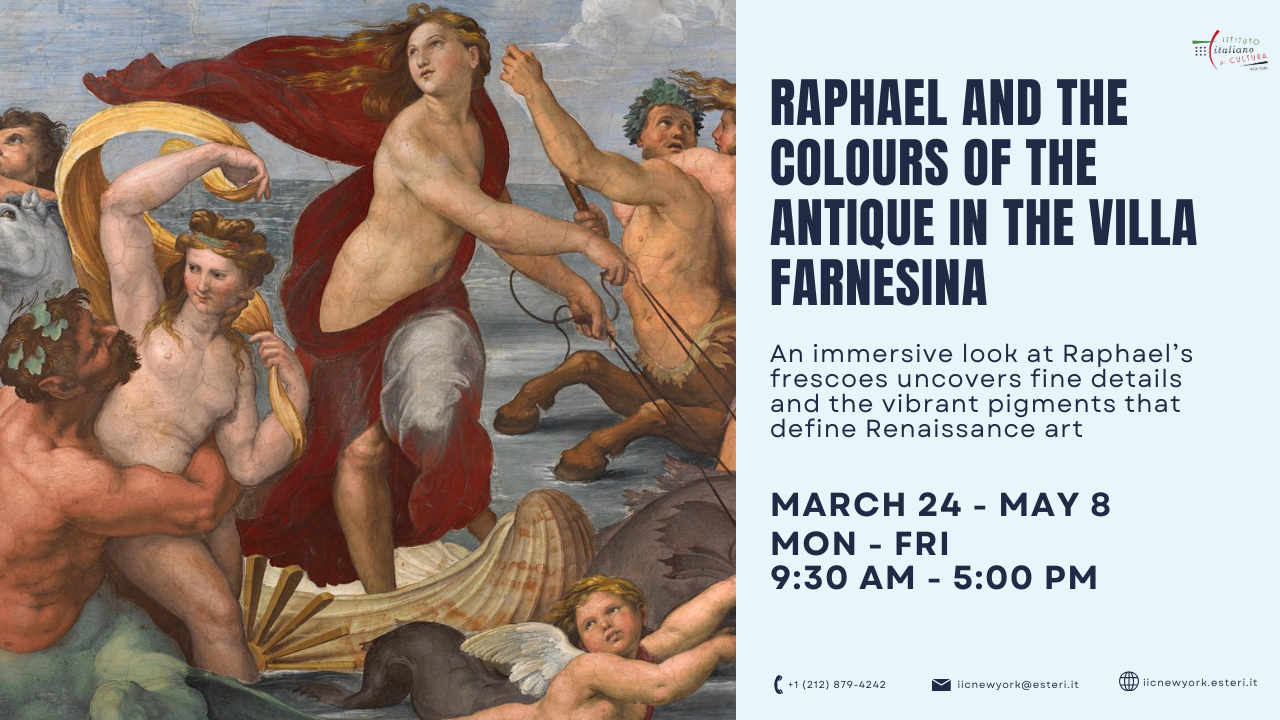
The exhibition “Raphael and the Colors of Antiquity at the Villa Farnesina,” (March 24 – May 8, M-F 9:30 AM 5:00 PM) offers visitors a close encounter with the frescoes in the loggias of Villa Farnesina, created by Raphael and his workshop, and sheds light on the most recent discoveries concerning the origin of some of the pigments used by the Renaissance master.
Through an interactive system, visitors will be able to virtually explore the Loggia of Cupid and Psyche at Villa Farnesina in Rome and admire — as if from only a short distance away — the details of the approximately 170 species of fruits and flowers, including roots, stems, bulbs, leaves, and mushrooms depicted in the festoons. These details are normally difficult to observe during an on-site visit, as the vault is located about eight meters above the floor.
Beyond their remarkable aesthetic beauty, the decorations are also notable because Raphael depicted fruits and plants originating from all parts of the world known at the time, including the American continent, only a little more than twenty years after the first European explorers had landed there.
Demonstrating the vibrant intellectual atmosphere of Raphael’s workshop, analyses conducted with advanced technologies by the Italian Institute for Conservation and Restoration on the frescoes of the two loggias of Villa Farnesina — the Loggia of Cupid and Psyche and the Loggia of Galatea — have revealed the use of pigments already known and employed in antiquity, such as Egyptian blue and Naples yellow.
Samples of these pigments, together with explanations of their origin and of why Raphael and his workshop chose to employ them again in this Renaissance masterpiece, will be displayed at the Institute.
The exhibition opens concurrently with “Raphael: Sublime Poetry” at the Metropolitan Museum of Art in New York, curated by Carmen Bambach, the largest exhibition ever dedicated to Raphael in the United States.