


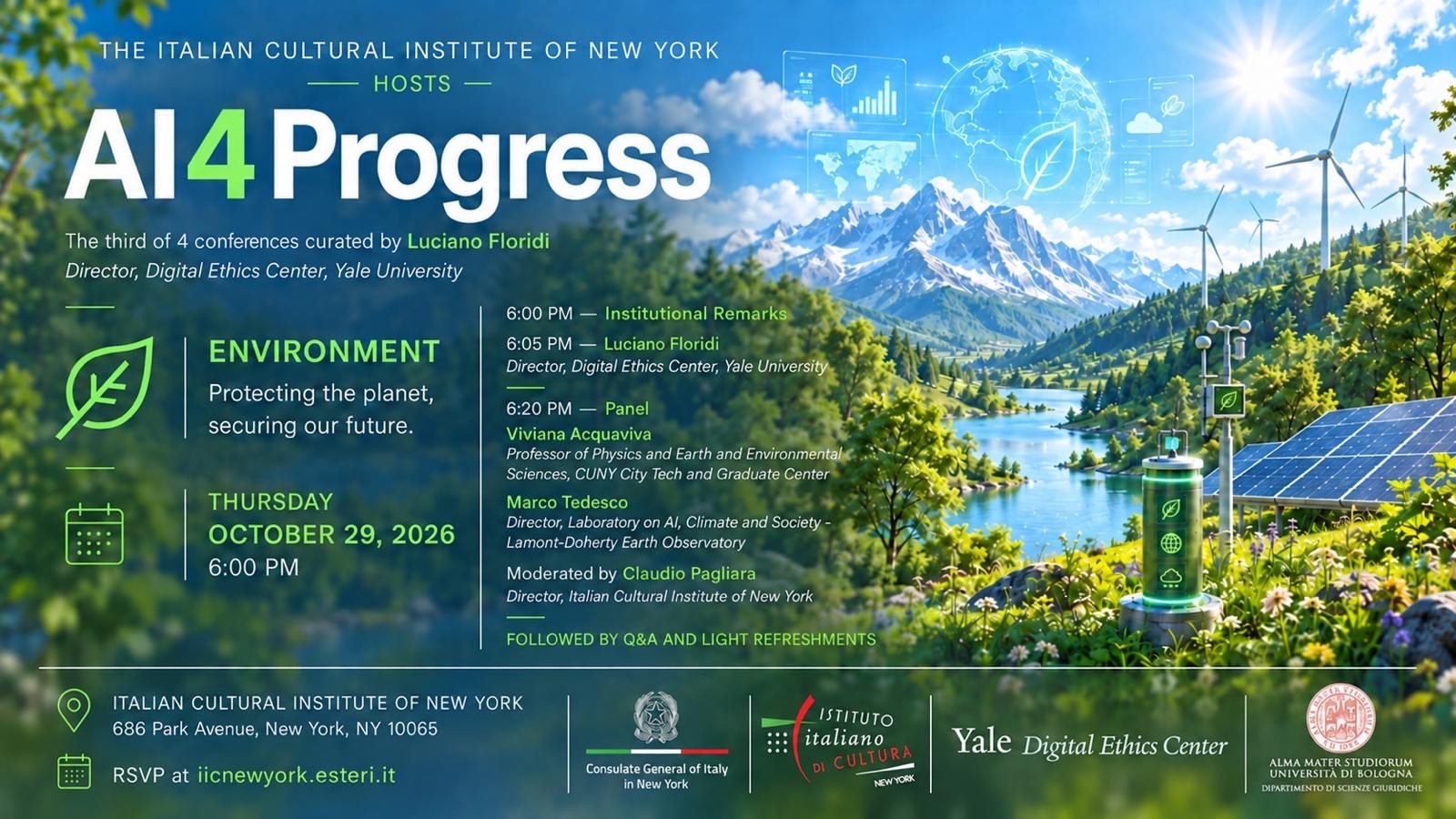
Can artificial intelligence help us not only better understand climate change, but also address it?
Viviana Acquaviva starts with data: how can machine learning identify patterns and signals in vast amounts of scientific information that may escape human analysis? Marco Tedesco starts with the planet: how can AI, satellites, and climate models help us understand and predict environmental changes that will have concrete consequences for our lives? From data to knowledge, from knowledge to prediction, from prediction to action.
But there is also a paradox: AI can help us protect the planet, yet it consumes energy and natural resources itself. How can we govern it so that its overall impact on the environment is positive?
Program
6:00 PM – Institutional Remarks
6:05 PM – Introduction
Luciano Floridi – Director, Digital Ethics Center, Yale University
6:20 PM – Panel
Viviana Acquaviva, Professor of Physics and Earth and Environmental Sciences, CUNY City Tech and Graduate Center
Marco Tedesco, Lamont Research Professor, Lamont-Doherty Earth Observatory, Columbia Climate School and Director, Laboratory on AI, Climate and Society – Lamont-Doherty Earth Observatory
In conversation with: Claudio Pagliara – Director, Italian Cultural Institute of New York
This is the third of four conferences curated by Luciano Floridi in collaboration with the Italian Cultural Institute of New York. Each conference addresses a crucial area for human progress.
Education: September 22, 6:30 PM – RSVP
Health: October 13, 6:00 PM – RSVP
Environment: October 29, 6:00 PM – RSVP
Business: November 9, 6:00 PM – RSVP
Artificial intelligence carries risks, some of them serious, which we do not intend to overlook; but history has shown that technological innovation cannot simply be halted, so the more productive question is how this technology can be governed and directed towards human progress rather than allowed to undermine it. Each evening therefore brings together two speakers with distinct – and sometimes contrasting – perspectives, in a conversation meant to be substantive, lively, and accessible to a general audience.
The format calls for Luciano Floridi to open each event with a fifteen-minute introduction to frame the topic. This is followed by a panel moderated by the Director of Italian Cultural Institute, Claudio Pagliara. The discussion will be followed by an extensive Q&A with the audience.
Bio

Luciano Floridi è John K. Castle Professor in the Practice of Cognitive Science e Direttore fondatore del Digital Ethics Center presso la Yale University. È inoltre Professore di Sociologia della Cultura e della Comunicazione presso il Dipartimento di Scienze Giuridiche dell’Università di Bologna. Riconosciuto come una delle voci più autorevoli della filosofia contemporanea, secondo Scopus è il filosofo vivente più citato al mondo. Ha aperto nuove prospettive nella filosofia e nell’etica dell’informazione, diventando uno dei principali interpreti della rivoluzione digitale, grazie ai suoi contributi fondamentali alla definizione dei quadri normativi della società digitale. La sua produzione scientifica comprende oltre 400 pubblicazioni e spazia dalla filosofia dell’informazione all’etica digitale, dall’etica dell’intelligenza artificiale alla filosofia della tecnologia e alla storia della filosofia. Numerose sue opere sono state tradotte e pubblicate in tutto il mondo. Tra i suoi libri più recenti figurano The Ethics of Artificial Intelligence (Oxford University Press, 2023) e The Green and the Blue: Naive Ideas to Improve Politics in the Digital Age (Wiley, 2023). Artificial Agency: Explorations of a Post-AI Culture (Wiley) e Encounters: An Experiment in Distant Writing (Columbia University Press) saranno pubblicati nel 2027. Nel 2022 è stato nominato Cavaliere di Gran Croce dell’Ordine al Merito della Repubblica Italiana per i suoi contributi alla filosofia.

Viviana Acquviva is professor of physics at the New York City College of Technology and the Graduate Center, City University of New York, and the recipient of a PIVOT fellowship and a PIVOT research award to apply AI tools to problems in climate. She was named one of Italy’s fifty most inspiring women in technology by InspiringFifty, which recognizes women in STEM who serve as role models for girls around the world. Her research interests are: evaluating and improving the forecasting skill of global climate models using ad-hoc metrics, predictive modeling; reconstructing full spatio-temporal geophysical fields, in particular ocean carbon, from sparse and biased data, using statistics, machine learning, and AI; Studying how AI tools can be used responsibly to improve research workflow, and how principles of ethical AI can be translated into an actionable framework for scientists.

Dr. Marco Tedesco is a Lamont Research Professor at Columbia University’s Lamont-Doherty Earth Observatory, where he directs the Laboratory of AI, Climate and Society and chairs the Lamont AI Working Group. Dr. Tedesco’s research focuses on polar regions, high-latitude fieldwork, global climate change and its implications for the economy, real estate and climate justice. His current research examines the energy, grid, and community consequences of the data center buildout, as well as machine-learning emulators of the Greenland Ice Sheet, algorithmic auditing of climate and property risk models. He leads the Earth Network on AI, Climate & Society.
It is not possible to make multiple reservations with the same email address.
Register to the Event